
China Import Duty in India: BCD, SWS and IGST Explained with Worked Examples
How Indian customs duty on Chinese goods is built: assessable value, BCD by HSN code, Social Welfare Surcharge, IGST and anti-dumping duty, with examples.
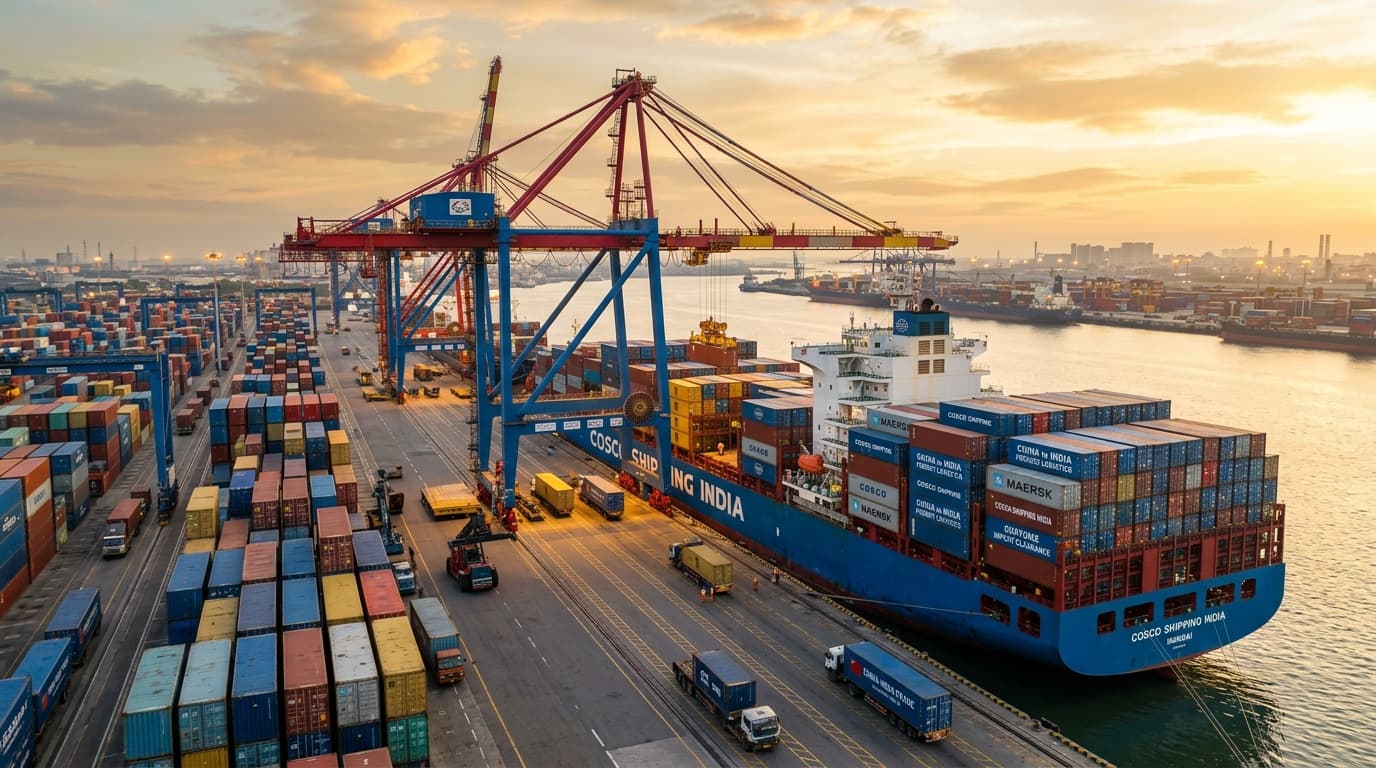
1. The Duty Stack in One Picture
Indian customs does not charge one duty on an import; it charges a sequence, each calculated on a base that includes the one before. For goods from China the sequence is: find the assessable value; charge Basic Customs Duty (BCD) on it; charge Social Welfare Surcharge (SWS) on the BCD; charge IGST on the value plus BCD plus SWS; and, for some products, add anti-dumping duty or a compensation cess. Of these, IGST is recoverable by a GST-registered importer as input tax credit; the others are a cost. The import from China to India guide places this inside the whole import process; this article is the arithmetic.
2. The Assessable Value
Duty is charged on the CIF value: the price paid for the goods plus the freight to the Indian port plus insurance, converted to rupees at the customs exchange rate notified for the date of the Bill of Entry. Where the invoice is FOB and the freight is known from the bill of lading, the actual freight is added. Where freight cannot be ascertained, the valuation rules take 20% of the FOB value for sea shipments; where insurance is not evidenced, 1.125% of the FOB value is added. The old 1% "landing charge" was removed from the valuation rules in 2017 and is no longer added. Customs may also question a declared value it considers low against comparable imports and reassess it; keep the purchase contract and the payment record with the file.
3. Basic Customs Duty
BCD is a percentage of the assessable value fixed for each heading of the Customs Tariff by its eight-digit HSN code, and changed by the Union Budget and by notification during the year. Rates range from nil on some inputs to high rates on finished consumer goods the government wishes to protect. Goods from China pay the standard rate: India has no free trade agreement with China, so the concessional rates that apply to some ASEAN or Japanese goods with a certificate of origin do not apply. The classification therefore decides the duty, and a wrong HSN code is the most common cause of a duty dispute; agree the code with your customs broker before the goods ship.
4. Social Welfare Surcharge
SWS is charged at 10% of the BCD amount, not of the goods' value. On goods whose BCD is nil, SWS is nil; some headings are specifically exempted. It is a cost that stays in the landed price.
5. IGST and the Credit That Comes Back
IGST on imports is charged at the GST rate for the product (5%, 12%, 18% or 28%) on the assessable value plus BCD plus SWS plus any anti-dumping duty or cess. A GST-registered importer takes the IGST paid at customs as input tax credit against GST collected on sales, so for a registered business it is a cash flow item, not a cost: paid at the port, recovered through the GST return. An unregistered importer, or one selling exempt goods, bears it as a cost. Compensation cess, charged on a few product categories, follows the same base and is also creditable against cess liability.
6. Anti-Dumping and Other Duties on Chinese Goods
India imposes anti-dumping duty on a large number of products originating in China after investigations by the Directorate General of Trade Remedies: categories of chemicals, steel and aluminium products, glass, tyres, certain machinery and consumer goods have carried such duties at various times. The duty is specific to the product description, the country of origin and often the producer, is expressed either as a percentage or as a fixed amount per unit, and runs for a fixed period that can be extended. It is charged in addition to BCD and is included in the IGST base. Before you price a product from China, check the list of duties in force on the DGTR site for your product description; an anti-dumping duty discovered at the port can erase the margin. Countervailing duties and safeguard duties exist for a smaller number of products.
7. Two Worked Examples
Example 1: kitchen appliances, assessable value ₹10,00,000, BCD 20%, IGST 18%, no anti-dumping duty.
- BCD = ₹10,00,000 × 20% = ₹2,00,000
- SWS = ₹2,00,000 × 10% = ₹20,000
- IGST base = ₹10,00,000 + ₹2,00,000 + ₹20,000 = ₹12,20,000; IGST = ₹12,20,000 × 18% = ₹2,19,600
- Paid at customs = ₹4,39,600; cost after IGST credit = ₹2,20,000 (22% of the assessable value)
Example 2: the same value with an anti-dumping duty of 10% and IGST 18%.
- BCD ₹2,00,000; SWS ₹20,000; anti-dumping duty ₹1,00,000
- IGST base = ₹13,20,000; IGST = ₹2,37,600
- Paid at customs = ₹5,57,600; cost after IGST credit = ₹3,20,000 (32% of the assessable value)
The rates in both examples are illustrative. The import duty calculator runs the same arithmetic for your value and rates, and the landed cost calculator starts from the invoice and adds freight, insurance and port charges to reach the cost per unit.
8. Finding the Rate for Your Product
- Identify the eight-digit HSN code with your customs broker; the product's material, function and form decide it.
- Read the BCD rate for that heading in the current Customs Tariff on the CBIC site, and check for any notification changing it.
- Check the GST rate schedule for the IGST rate.
- Check the DGTR list of anti-dumping and countervailing duties in force for the product description and China as origin.
- Check whether the product is under an import policy condition (restricted, or requiring BIS, WPC or other certification) on the DGFT and BIS sites, because a product that cannot be cleared has an infinite duty rate.
Where you want the rate confirmed by someone who does this daily, our China import consultation includes the classification, the duty check and the landed cost for your product.
Frequently Asked Questions
Is IGST on imports a cost?
For a GST-registered importer, no: it is paid at the port and recovered as input tax credit against GST on sales. For an unregistered importer or exempt sales it is a cost.
Does India charge extra duty on Chinese goods?
Not a general surcharge. China pays the standard BCD rate because there is no trade agreement, and many specific products carry anti-dumping duty after DGTR investigations. Check your product on the DGTR list.
What is the assessable value?
The CIF value in rupees: goods plus freight to the Indian port plus insurance, at the customs exchange rate on the Bill of Entry date. Notional freight (20% of FOB by sea) and insurance (1.125% of FOB) are used where the actual figures are not available.
Why did customs charge more duty than I calculated?
Usually a different HSN classification, an anti-dumping duty on the product, or a reassessed value. Ask the broker for the assessment details on the Bill of Entry and compare line by line.
Sources
- Central Board of Indirect Taxes and Customs: Customs Tariff and notifications · BCD rates, SWS, IGST on imports, valuation rules
- Directorate General of Trade Remedies · anti-dumping and countervailing duties in force
- Goods and Services Tax portal · input tax credit on IGST paid at import
- ICEGATE, Indian Customs electronic gateway · Bill of Entry filing, duty payment, AD code registration
- China Import Duty
- BCD Rates India
- IGST on Imports
- Customs Duty Calculator
- Anti-Dumping Duty
Get Expert Guidance on China Travel & Sourcing
Share your details below. We'll save your inquiry and immediately connect you with our China specialist on WhatsApp.
Prefer to call us directly?Call +91-8586939476
More Essential Guides for Importers
Importing for the First Time?
Tell us the product. We set out the registrations, duties and steps for it.