
FOB vs EXW for China Imports: What Each Term Makes You Responsible For, and Which to Choose
FOB vs EXW (and FCA) for importing from China to India: who loads, who clears export, where risk passes and how Indian customs values the goods.
1. The Short Answer
For a sea shipment from China, ask for FOB at a named Chinese port (for example FOB Ningbo or FOB Shenzhen), or FCA if your goods travel in a container the supplier delivers to a terminal or to your forwarder. Avoid EXW unless your freight forwarder will act as the exporter in China and you have agreed in writing who pays for loading and export clearance. EXW prices look lower because the supplier stops at its gate; the trucking, loading, export declaration and the risk on the way to the port all become yours. This guide is from our freight desk in Karol Bagh, Delhi, and draws on ICC's own Incoterms material and the Indian customs valuation rules listed at the end.
2. Incoterms 2020 in Two Paragraphs
Incoterms are the International Chamber of Commerce (ICC) rules that define, in three letters, where the seller delivers the goods, who pays which costs, who carries out export and import clearance, and when the risk of loss or damage passes from seller to buyer. The current edition, Incoterms 2020, has been in force since 1 January 2020. ICC has started work towards an Incoterms 2030 revision, but nothing has been published; Incoterms 2020 remains the edition to name in your contract.
An Incoterm does not decide the price, the payment terms or when ownership passes; those belong in the purchase contract. It works only if the contract names the rule, the place and the edition: "FOB Ningbo, Incoterms 2020", not just "FOB".
3. EXW: What the Buyer Takes On
Under Ex Works, the seller only makes the goods available at its own premises, not loaded and not cleared for export. From that moment every cost and every risk is the buyer's: loading at the factory, trucking to the port, export customs clearance in China, port charges, the ocean freight and everything after. ICC's own guidance describes EXW as suitable mainly for domestic trade and advises exporters to use it, if at all, only for domestic sales.
The practical problem for an Indian buyer is export clearance. In China, export declarations are made by a registered consignor, and customs registration is available only to an entity established in China with a Chinese business licence. A buyer in Delhi has no such entity, so under EXW someone else (your forwarder's Chinese agent, or in practice the supplier) has to act as exporter. If that is not agreed in advance, the goods can sit at the factory, or the supplier will add the charges later.
4. FOB: Delivery on Board at the Chinese Port
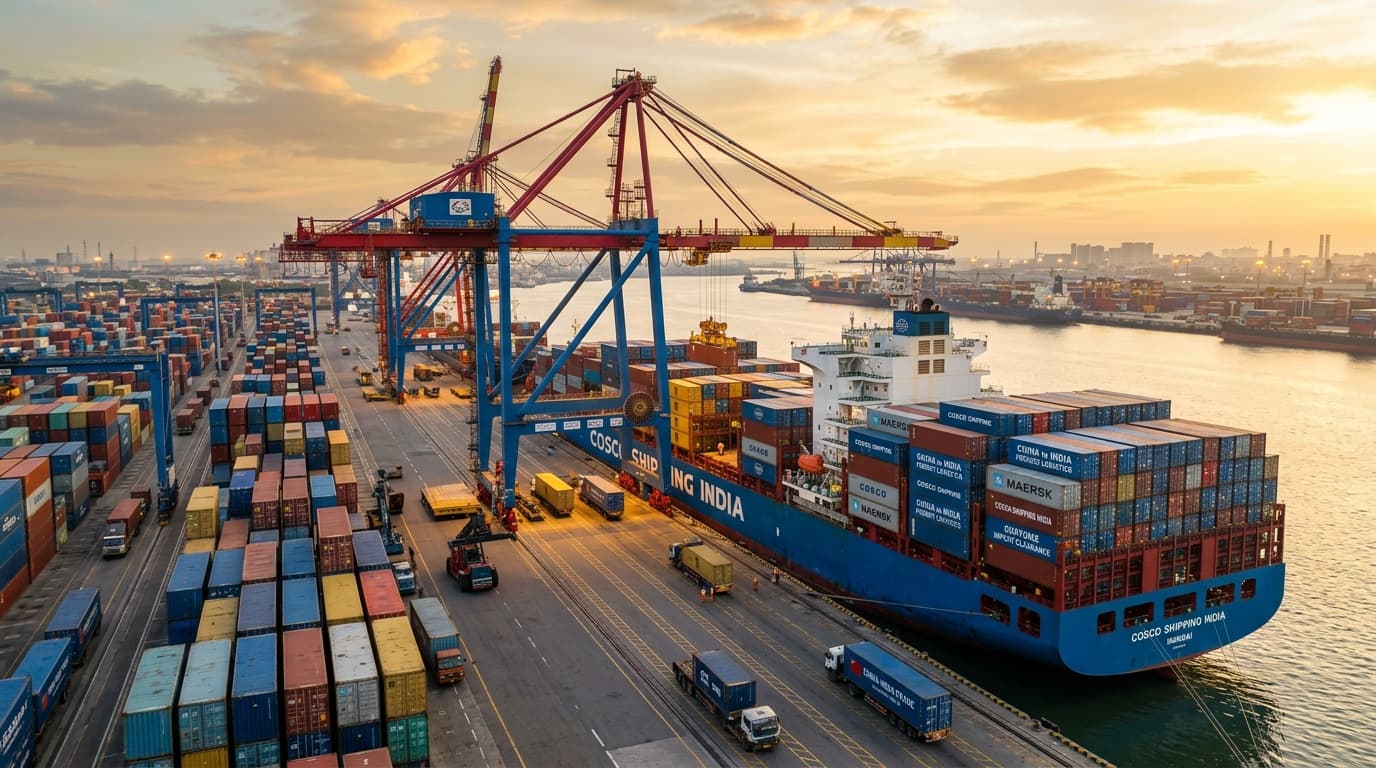
Under Free On Board, the seller delivers the goods on board the vessel nominated by the buyer at the named port of shipment. The seller handles and pays for packing, loading at the factory, inland transport to the port, export clearance and loading on board. Risk passes when the goods are on board; from there the ocean freight, insurance, Indian import clearance and duty are the buyer's. FOB may be used only for sea and inland waterway transport.
FOB suits Indian importers because the Chinese side, where you have the least control, stays with the supplier, while the freight, where you can compare forwarders, stays with you. The shipping guide explains how to compare forwarder quotes and what the destination charges are.
5. FCA: The Term ICC Recommends for Containers
ICC's guidance is that FOB is meant for goods loaded directly on board, and that FCA (Free Carrier) should be used when goods travel in containers or by multimodal transport, or are delivered to an inland or port terminal. Under FCA the seller clears the goods for export and delivers them to the carrier or forwarder nominated by the buyer at the named place. If that place is the seller's premises, the seller also loads them onto the collecting vehicle. Incoterms 2020 lets the parties agree that the buyer's carrier issues an on-board bill of lading to the seller, which matters when payment is by letter of credit.
In practice many Chinese suppliers still quote FOB for container cargo, and it works when both sides understand it. If your goods are consolidated at a forwarder's warehouse (common for Yiwu LCL shipments), FCA at that warehouse describes what actually happens.
6. EXW, FCA and FOB Side by Side
| Who does it | EXW (factory) | FCA (named place) | FOB (Chinese port) |
|---|---|---|---|
| Loading at the factory | Buyer | Seller, if delivered at its premises | Seller |
| Truck to port or terminal | Buyer | Seller up to the named place | Seller |
| Export clearance in China | Buyer | Seller | Seller |
| Risk passes to buyer | When goods are made available at the factory | On delivery to the buyer's carrier | When goods are on board |
| Ocean or air freight | Buyer | Buyer | Buyer |
| Import clearance and duty in India | Buyer | Buyer | Buyer |
| Modes | Any | Any | Sea and inland waterway |
7. How Each Term Changes the Customs Value in India
Indian customs charges duty on the value of the goods delivered to the place of importation, under Rule 10 of the Customs Valuation Rules 2007. Whatever the Incoterm, the cost of transport, loading and handling up to the Indian port, and insurance, is added to the price paid:
- EXW price: customs adds the Chinese inland transport, loading and export handling as well as the ocean freight and insurance. Keep the invoices for these, or customs may estimate them.
- FOB price: customs adds the ocean freight and insurance. Where the freight cannot be established, it is taken as 20% of the FOB value; where insurance cannot be established, 1.125% of the FOB value.
- CIF price: freight and insurance are already included.
Since 2017, loading, unloading and handling charges at the Indian port are no longer added to the value. The import duty guide shows the duty arithmetic on that value, and the landed cost calculator runs it for your figures.
On CIF imports, India no longer charges IGST separately on the ocean freight under reverse charge: the Supreme Court held in Union of India v. Mohit Minerals (May 2022) that it could not be levied, and the IGST notifications were amended from 1 October 2023. Ask your chartered accountant how this applies to your contracts.
8. Which to Choose
- First orders by sea: FOB at a named port, with your own forwarder. You see the freight you pay, and the supplier handles China.
- Consolidated or container cargo through a forwarder's warehouse: FCA at that warehouse, Incoterms 2020.
- EXW: only when the price difference is worth it and your forwarder confirms in writing that its Chinese agent will load, truck and clear the goods for export.
- CIF or CFR from the supplier: convenient, but you lose sight of the freight cost and the destination charges are often higher; compare with your own forwarder's FOB quote first.
Whatever you choose, compare suppliers on the same basis. Converting every quote to a landed cost per unit is what our China sourcing service does before you place an order.
Frequently Asked Questions
Is EXW cheaper than FOB?
The quoted price is lower, but the costs and risks between the factory and the ship move to you, including loading, trucking, export clearance in China and port charges. A buyer without a company in China also needs someone to act as exporter. Compare landed costs, not ex-works prices.
Who does export customs clearance under FOB?
The seller. Under FOB, Incoterms 2020, the seller clears the goods for export and delivers them on board the vessel at the named Chinese port.
Should I use FOB or FCA for container shipments?
ICC recommends FCA for containerised and multimodal cargo, because the goods are handed to the carrier at a terminal before loading. Many Chinese suppliers still quote FOB; either works if the contract names the rule, place and edition.
Is Incoterms 2030 in force?
No. ICC has begun work towards a revision, but Incoterms 2020 is the current edition and the one to name in contracts.
Sources
- International Chamber of Commerce: Incoterms rules · the current edition, Incoterms 2020
- ICC: Incoterms 2020 checklist and flowcharts (2024 update) · EXW, FCA and FOB obligations, and when to use FCA
- Jawaharlal Nehru Custom House: Public Notice 132/2017 · Rule 10 valuation amendment and the end of the landing charge
- International Chamber of Commerce: 2026 policy commissions workplan · work towards Incoterms 2030
- FOB vs EXW
- Incoterms 2020
- FCA Incoterm
- China Import Pricing
- Customs Valuation India
Get Expert Guidance on China Travel & Sourcing
Share your details below. We'll save your inquiry and immediately connect you with our China specialist on WhatsApp.
Prefer to call us directly?Call +91-8586939476
More Essential Guides for Importers
Have a Product in Mind?
Send the product, quantity and target price. We come back with suppliers and what it takes to order.